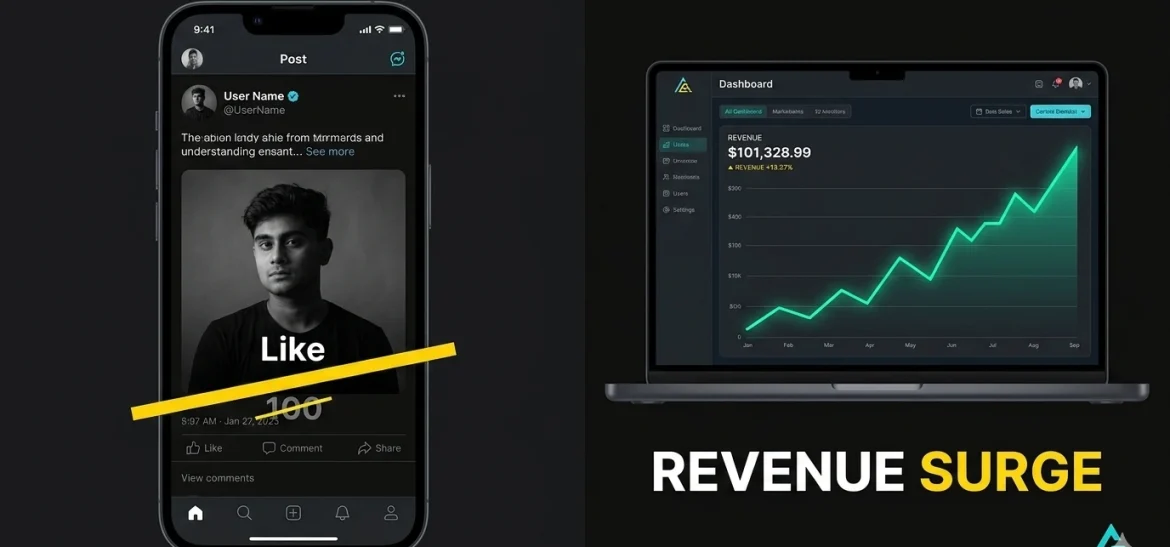
Let’s be honest for a moment. It feels amazing to open up Instagram or LinkedIn and see a flood of notifications. A post gets 500 likes, a couple of fire emojis in the comments, and maybe a few shares. Your team celebrates, the creative department feels vindicated, and everything looks great on paper.
But then you look at your stripe dashboard, your Shopify analytics, or your CRM pipeline. Nothing. No sales, no high-quality leads, and no actual customer growth.
The harsh reality is that double-taps do not pay rent, and followers do not fund payroll. Many brands fall into the dangerous trap of treating social channels like a vanity contest rather than a measurable client acquisition channel. If you are a business owner investing capital into organic posting hoping it will magically transform your bottom line, you are playing a losing game.
To scale a business today, you must pivot away from the pursuit of superficial popularity and move toward structured, direct-response advertising. Read on as we break down exactly how modern, conversion-focused social media marketing services convert casual scrollers into loyal, high-value paying customers.
Here’s What You’ll Learn in This Guide:
- The Vanity Trap: Why organic reach is declining and how likes deceive your business growth strategy.
- Direct-Response Architecture: The fundamental blueprint for social ads that capture commercial intent.
- The Psychology of the Click: How to craft ad hooks that stop the scroll and trigger checkouts.
- The AdsGrip Framework: How we build unified paid social systems focused entirely on your net profit.
Understanding the Broken Loop of Organic Engagement
To fix your social channel framework, you have to understand why the old playbooks are failing. Years ago, social platforms allowed brands to build an audience organically and reach them consistently. Today, the organic reach of a standard business page hovers somewhere around 2% to 3%. The platforms are built on a “pay-to-play” model.
This means when you pay an agency just to publish standard graphic templates three times a week, you are shouting into an empty room. Even worse, the few people who do double-tap your posts are rarely your ideal buyers. Likes are a low-friction action; it takes zero financial commitment to tap a screen.
High-growth digital marketing firms look at social media through a fundamentally different lens. We view social feeds as a massive, real-time marketplace where attention must be bought strategically and directed immediately into an optimized conversion funnel. Instead of asking “How can we make this post go viral?”, a seasoned strategist asks “How can we use this specific ad layout to lower our customer acquisition cost (CAC)?”
Why It Matters in Today’s Digital Landscape (The Death of Fluff Metrics)
The digital landscape has grown highly competitive, demanding that every single marketing rupee justify its existence:
- Data from recent enterprise commerce indexes highlights that over 70% of growing direct-to-consumer (D2C) and B2B brands have completely de-prioritized organic page management to shift their resources into targeted performance ad budgets.
- According to recent HubSpot social commerce updates, shoppers are increasingly buying products directly inside ad interfaces without ever visiting a brand’s main profile page, bypassing traditional brand exploration entirely.
- Industry tracking across prominent performance marketing companies reveals that ad account structures built entirely around “Engagement” objectives yield a significantly higher cost-per-sale compared to campaigns optimized for raw conversions.
If your current marketing partner spends hours analyzing your account’s follower growth instead of tracking your real-time return on ad spend (ROAS), they are running an outdated strategy. This is why scaling brands are parting ways with traditional firms and partnering with a dedicated digital marketing company in jaipur to rebuild their customer acquisition pipelines.
The Blueprint for Direct-Response Social Ads That Drive Sales
If you want your ad accounts to generate real revenue, stop running ads that look like ads. Use this strategic, direct-response framework instead:
1. The Scroll-Stopping Hook (First 3 Seconds)
The human thumb moves fast through a social media feed. If your ad creator starts with a slow, corporate logo animation, the user has already scrolled past. Your ad creative must use an immediate visual or textual hook that addresses a specific consumer pain point within the first three seconds. This could be a dramatic product demonstration, a provocative question, or an immediate call-out of an industry frustration.
2. Native User-Generated Content (UGC)
Consumers have developed banner blindness to polished, over-produced corporate commercials. The highest-converting ads running on paid social right now look like authentic content made by real people. Partner with a sophisticated social media marketing agency that builds structured networks of content creators to produce authentic reviews, unboxing videos, and problem-solving demonstrations that blend naturally into the user’s social feed.
3. Framing the Offer, Not Just the Product
An ad doesn’t fail because the product is bad; it fails because the offer is weak. Stop running ads that simply say “We sell shoes, click here.” Your ad must offer a compelling, clear reason to take action right now. This means bundling products together, introducing risk-reversal guarantees, highlighting limited-time introductory pricing, or pairing the purchase with an exclusive premium value-add.
4. The Single, Frictionless Conversion Path
Once a user clicks your social ad, their transition to your digital asset must be seamless. Do not send traffic from a highly specific product ad to your generic website homepage. Build hyper-focused, lightning-fast landing pages optimized specifically for mobile screens, featuring single-click checkouts via digital wallets to minimize drop-offs.
AI’s Role in Eliminating Waste in Paid Social
Let’s demystify how AI actually impacts modern paid social. Platforms like Meta and TikTok deploy powerful algorithms designed to find buyers based on deep behavioral data patterns. Attempting to manually micromanage every single demographic variable or lookalike percentage is an outdated way to run an ads agency.
The modern way to scale requires giving the platform AI model the correct inputs to do its job. This means feeding the algorithm a varied mix of high-quality ad creatives and setting up pristine server-side tracking data loops. At AdsGrip, we use algorithmic automation to test multiple copy variations and match them to audience segments, allowing our human strategists to stay focused on high-level market positioning, creative direction, and protecting your margins.
Common Mistakes Brands Make on Paid Social
- Mistake: Optimizing for the Wrong Objective. Selecting the “Traffic” or “Engagement” campaign goal inside your ad manager tells the platform to find people who click or like things, not people who buy things.
- The Guidance: Always set your campaign objective to “Conversions” or “Sales” from day one, forcing the algorithm to seek out real commercial intent.
- Mistake: Abandoning Ad Creative Too Early. Pausing an ad group because it didn’t get sales within 48 hours resets the platform’s learning phase.
- The Guidance: Give your campaigns adequate data budgets and runtime so the machine-learning tools can optimize delivery efficiently.
- Mistake: Treating Social Platforms as Isolated Channels. Failing to match your social ad angles with your search query intent leaves gaps in your sales funnel.
- The Guidance: Ensure your paid search strategies build on the demand created by your paid social campaigns, capturing shoppers whichever way they choose to search.
Results, Scaling Timelines & Strategic Expectations
Building a profitable, predictable paid social engine requires a realistic appreciation of platform mechanics:
- Days 1–30 (The Setup & Validation Window): This phase is spent installing server-side tracking pixels, setting up advanced tracking, and launching structured creative tests. Success here looks like identifying which hook angles yield the lowest cost-per-click and the highest add-to-cart rates.
- Days 31–60 (The Efficiency Phase): We scale the budgets of our winning ad creative variants while cutting the underperforming ones. Your overall customer acquisition cost begins to stabilize, and clear, consistent returns on ad spend start to take shape.
- Days 61–90 and Beyond (The Scale Window): With reliable creative assets and a rich pipeline of first-party conversion data established, we aggressively scale spend into profitable audiences, transforming your ad account into a predictable customer generation engine.
Why Choose AdsGrip? Your Conversion-Driven Growth Partner
Navigating the constant changes of digital ad platforms requires an execution partner who looks past vanity metrics to focus entirely on your net profit. AdsGrip stands apart from traditional agencies because we measure our worth solely by your business growth.
Our team combines certified expertise across advanced algorithmic ad management, high-converting creative design, first-party data infrastructure, and full-funnel content design. We don’t sell generic monthly posting packages. We take time to analyze your specific margins, audit your existing ad accounts, and deploy tailored digital acquisition frameworks that treat your capital with deep respect.
Whether you are an ambitious local startup looking for an elite digital marketing agency in jaipur or an established consumer brand looking to expand alongside the best marketing companies in India, we supply the technical precision and data transparency needed to turn social media into your most profitable revenue engine.
Frequently Asked Questions (FAQ)
Q1: If organic social posting doesn’t drive fast sales, should we stop doing it completely?
You shouldn’t abandon it entirely, but you should lower its resource priority. Think of your organic social profile as a digital business card. It needs to look active and professional so prospects can verify your legitimacy, but your actual customer acquisition should be driven by your paid ad funnel.
Q2: What is a realistic starting ad budget for testing paid social ads?
Your testing budget is relative to your product pricing. A solid baseline rule is to allocate an ad set budget that allows you to comfortably buy at least 50 core conversion actions per week, giving the platform’s machine-learning engine enough data signals to optimize your ad delivery.
Q3: What is the difference between User-Generated Content (UGC) and traditional influencer marketing?
Influencer marketing relies on paying a creator with a large following to post an ad to their audience. UGC focuses strictly on the content asset itself. You take a high-converting, realistic video created by a consumer and run it as an ad through your own brand account, targeting your exact target demographic.
Q4: How do we counter ad fatigue when our performance numbers start to decline?
Ad fatigue occurs when your target audience has seen the same creative asset multiple times. The fix is not altering your campaign budget or changing your target settings; it’s regularly introducing fresh creative assets, new visual hooks, or different angle concepts into your ad sets.
Q5: How can I tell if my social media marketing services are focusing on the right metrics?
Check your weekly reports. If your marketing partner leads with impressions, video view counts, and profile clicks, they are highlighting vanity metrics. A conversion-first partner will lead with cost-per-lead, customer acquisition cost, conversion rate, and net return on ad spend.
Conclusion: Move from Attention to Acquisition
The digital space moves too quickly to spend valuable time and money chasing superficial online approval. Likes, comments, and followers are great for the ego, but they do nothing to expand your operations or build long-term business value. The future belongs entirely to brand leaders who treat their social media platforms as serious, performance-driven customer acquisition assets.
Stop settling for double-taps and start demanding direct revenue.
Ready to turn your social media channels into a predictable customer acquisition machine? Connect with the growth strategists at AdsGrip today to book your comprehensive ad account audit.
To Know More: Best SEO Company in Jaipur: The New SEO, GEO & AEO Playbook