Post
GEO vs SEO: What’s the Difference and Why It Matters in 2026
A few months ago, we had a client call us in a mild panic. Rankings hadn’t moved. Traffic had dropped almost 30% on their best-performing page, with nothing to explain it in Search Console except the same position they’d held for a year. The cause wasn’t a penalty. It was Google’s AI Overview quietly answering the exact question their article used to own, without sending a single click their way.
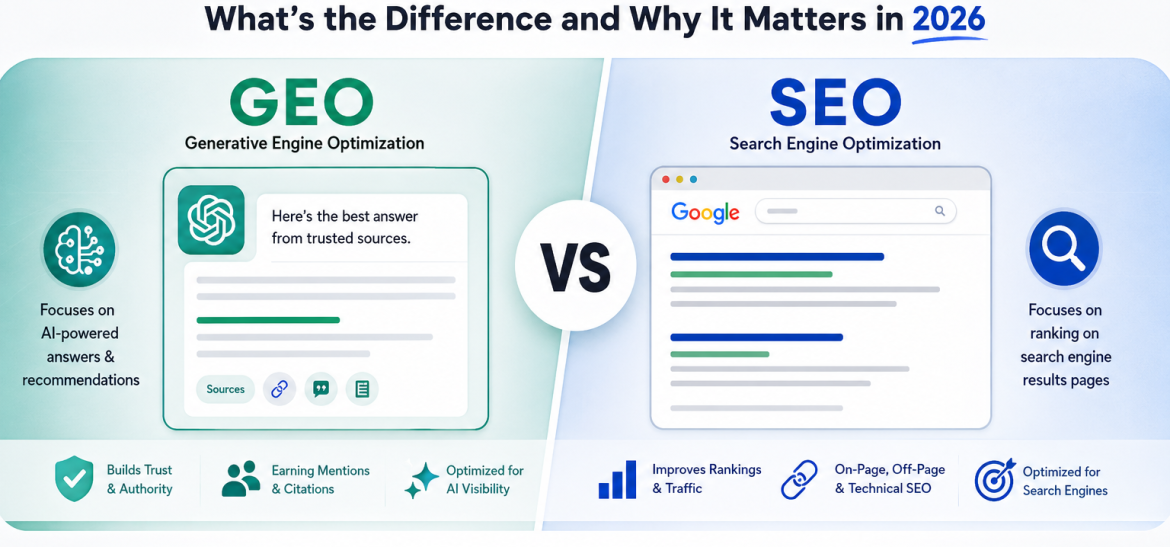
Quick Answer: SEO ranks your website on standard search engines like Google and Bing. GEO gets your content cited or mentioned within an AI answer generated by models like ChatGPT, Perplexity, or Google AI Overviews. SEO gives you access to a results placement. GEO gives you access to an answer placement.
They’re related. They’re not the same, and treating them as interchangeable is exactly how brands end up like the client above.
What Is SEO?
Search engine optimization (SEO) is the common practice of making a website easier for search engines to crawl, understand, and rank. It relies on a well-established set of pillars: targeting keywords that match what people actually enter in the search box, getting backlinks from other trustworthy sites that support your content, maintaining a clean technical structure so crawlers can access and index your pages, and using on-page signals like title tags, headers, and meta descriptions to inform Google about the content of a page.
If you want the fundamentals in more depth, our SEO services page walks through how we approach technical SEO, on-page optimization, and link building for Jaipur-based and national clients.
What Is GEO (Generative Engine Optimization)?
Generative engine optimization is newer, and it works on a different mechanism entirely. Instead of crawling and ranking a list of pages, tools like ChatGPT, Perplexity, Google’s AI mode, and Microsoft Copilot pull relevant passages from across the web, synthesize them, and hand the user one direct answer, often with a small number of source citations tucked underneath.
Here’s the part most explainers skip: these systems don’t evaluate your whole page the way a traditional crawler does. Many of them retrieve at the passage level, pulling out a specific paragraph, table, or list that directly answers the query, then stitching several of these fragments together into a response. This is roughly how retrieval-augmented generation (RAG) works under the hood: the model isn’t just “reading” your site; it’s retrieving the most relevant chunk of it and deciding whether that chunk is trustworthy enough to quote or cite.
GEO, then, is the practice of writing and structuring content so that those specific chunks are clear, self-contained, well-supported, and easy for a retrieval system to lift out and trust.
GEO vs SEO: The Core Differences
| SEO | GEO | |
| Goal | Rank high on a results page | Get cited or referenced inside an AI-generated answer |
| Target platforms | Google, Bing, other traditional engines | ChatGPT, Perplexity, Google AI Overviews/AI Mode, Copilot, Claude |
| Output type | A list of ranked links | One synthesized, often multimodal answer |
| Core signals | Keywords, backlinks, technical health | Clarity, structure, direct answers, third-party trust signals |
| Measurement | Rankings, organic traffic, CTR | Citation frequency, brand mentions, share of voice in AI answers |
| Content format | Primarily text-based | Text, tables, code, lists whatever answers the prompt best |
The traffic implication is the one that actually keeps people up at night. Zero-click search has been climbing for years, and AI overviews have accelerated it further; a growing share of Google searches now end without the user visiting any website at all. That doesn’t mean the search disappeared or that value evaporated. It means the “win” moved from a click to a mention, and most analytics dashboards still aren’t built to track that.
Where GEO and SEO Overlap
None of this means you’re building two separate content strategies from scratch. The foundation underneath both disciplines is nearly identical.
1. E-E-A-T: Both approaches give awards for genuine E-E-A-T (experience, expertise, authoritativeness, and trustworthiness).
2. Good structure: Both will get a kick from good, concrete, well-structured, and updated content rather than filler.
3. Technical SEO, as with organic, slowness or non-crawleability: a site often fails when interacting with any number of bots, including an AI model.
4. Schema / Structured Data: Both get big wins from structured data, although there are schemas designed for Google.org; as we’ll see below, you can tag your own information so you don’t necessarily have to provide it when requesting it; mark where to find it.
If you’re building this foundation for the first time, it’s worth pairing SEO work with a broader digital marketing services strategy rather than treating either discipline in isolation.
Why the Difference Matters More in 2026?
This is the part that’s changed. A year or two ago, GEO was a “nice-to-have” experiment for brands with spare budgets. That’s no longer true, for three reasons.
User research behavior has genuinely shifted. People are starting product and service research directly inside ChatGPT or Perplexity rather than Google, particularly for comparison-heavy or advice-heavy queries. If your content was written purely to satisfy a Google crawler, it may never even enter the pool these tools retrieve from.
Being invisible in an AI answer costs you the first impression, even when your SEO is strong. A page can rank #1 on Google and still never appear in the AI Overview sitting directly above it, because the AI Overview and the organic results below it are generated by somewhat different evaluation logic. Marketers who only track rankings are, increasingly, missing half the picture.
The cost compounds. Every AI answer that cites a competitor instead of you is a small, repeated loss of share of voice, of trust signal, and of early-funnel visibility, and these losses don’t show up cleanly in a rank tracker. By the time it’s obvious in your traffic numbers, a competitor has usually already built a lead in AI visibility that takes months to close.
How LLMs Actually Decide What to Cite
Understanding this mechanism is the single highest-leverage thing you can do for GEO, and it’s the piece most “GEO vs SEO” articles gloss over.
Retrieval happens at the passage level, not the page level. A generative engine isn’t asking, “Is this whole page authoritative?” It’s asking, “Does this specific paragraph or table directly and clearly answer the user’s question?” A 2,000-word article with one buried, well-phrased answer can get cited over a shorter page that never quite states its point plainly.
Third-party trust signals carry unusual weight. Reviews, mentions on forums like Reddit and Quora, coverage from news outlets, and citations from other authoritative sites all feed into how much an AI system trusts a claim, sometimes more heavily than it weighs your own domain authority. This is part of why “search everywhere optimization,” not just on-site SEO, has become part of the GEO conversation.
Structure is a trust signal in itself. Lists, tables, clearly labeled FAQs, and direct-answer opening sentences are easier for a retrieval system to lift cleanly and quote accurately. Dense, meandering paragraphs that bury the answer three sentences in are harder to trust and easier to skip.
Does GEO Replace SEO?
No, and anyone telling you otherwise is selling something. GEO is built entirely on top of SEO’s foundation. AI search engines still need to discover, crawl, and index your content before they can ever retrieve or cite it. A site with broken technical SEO, thin content, or no backlink profile isn’t going to suddenly show up in AI Overviews just because it added an FAQ section. GEO is an additional layer of optimization, not a replacement discipline.
How to Optimize for Both GEO and SEO in 2026?
Firstly, we ensure you actually have an SEO foundation. There is the technical to the technical; you can only have your best foot in the door if you address your real keyword targets and have a legitimate backlink strategy. Very rarely do we come across businesses that jump to “GEO tactics” that have already done this fundamental task.
From there, layer in the GEO-specific work: rewrite key sections so they open with a direct, quotable answer; add genuine FAQ blocks phrased the way people actually ask questions out loud; implement schema markup so the structure is machine-readable, not just visually clean; and build tables wherever you’re comparing options, since tables extract unusually well into AI answers.
Don’t stop at your own domain. Expanding into forums, digital PR placements, and industry publications gives generative engines more independent places to find and verify claims about your brand, which is exactly the kind of third-party trust signal these systems weigh heavily. If you need a broader hand with this, our digital marketing consultancy team builds these cross-channel strategies for clients rather than optimizing SEO and GEO in silos.
Finally, don’t neglect multimedia. Add real alt text, transcripts for video, and captions; all of it is additional text a generative engine can retrieve and cite, and none of it costs much to produce properly.
Measuring Success: GEO Metrics vs. SEO Metrics
| SEO Metrics | GEO Metrics |
| Keyword rankings | Citation frequency in AI answers |
| Organic traffic | Brand mentions across AI platforms |
| Click-through rate | Share of voice vs. competitors in AI responses |
| Backlink count/quality | Quality and conversion rate of AI-referred traffic |
The honest caveat here: GEO measurement tooling is still maturing. Unlike SEO, where Search Console and rank trackers have been refined for two decades, AI-visibility tracking is a newer category, and the tools available today vary in accuracy and coverage. Treat early GEO metrics as directional rather than gospel, and revisit your tracking stack every few months as the space matures.
Which Should You Prioritize First?
This depends more on your business model than most articles admit. If you’re in a high-intent, transactional space local services, e-commerce, anything where users are ready to buy and click through to compare prices a strong SEO foundation still drives the bulk of your revenue, and GEO should be layered on as a visibility and brand-trust play rather than a primary channel.
For a highly informational/thought-leadership-focused niche, think B2B software, health care, finances, etc. Invest in GEO, and do so earlier and with greater emphasis: A massive portion of your audience is receiving their initial (and occasionally final) answer directly within an AI tool prior to arriving at a website.
Most businesses land somewhere in between, and the honest answer is sequencing, not exclusivity: fix the SEO foundation first, then layer GEO on top as fast as your content team can manage it.
Key Takeaways
- SEO gets you discovered: It’s still what earns your spot on the traditional results page; nothing about that job has gone away.
- GEO gets you included in the answer: When someone asks ChatGPT or gets a Google AI Overview instead of a list of links, this is what decides whether they’re part of that response.
- Neither one replaces the other: They solve different problems, and dropping either one leaves a real gap the other can’t fill.
- 2026 isn’t the year to pick a side: it’s the year the cost of not picking both started showing up on the balance sheet. The gap between brands doing one and brands doing both is no longer theoretical; it’s visible in traffic and visibility numbers right now.
- This works best as one connected strategy, not three separate line items: A team that treats SEO, AI search visibility, and social distribution as parts of the same system rather than isolated tasks is what actually closes that gap.
FAQs
What is the difference between GEO and SEO?
SEO ranks your website on traditional search engine results pages. GEO gets your content cited or referenced inside AI-generated answers from tools like ChatGPT and Google AI Overviews.
Why does GEO matter more in 2026 than before?
More users are starting research directly in AI tools, and being absent from an AI answer costs you visibility even when your traditional rankings are strong a gap that widens the longer it’s ignored.
Does GEO replace SEO?
No. GEO builds on a strong SEO foundation; AI search engines still need to crawl and index your content before they can retrieve or cite it.
Do I need GEO if I already rank well in Google?
Yes, if you want visibility inside AI overviews, since ranking well organically doesn’t guarantee inclusion in the AI-generated answer above those results.
How do I get cited in AI Overviews or ChatGPT?
Structure content with clear, direct answers near the top of each section, use tables and FAQs, add schema markup, and build genuine third-party trust signals like reviews and mentions on other credible sites.
What metrics show GEO is working?
Citation frequency, brand mentions across AI platforms, and share of voice compared to competitors in AI-generated answers, tracked alongside, not instead of, your traditional SEO metrics.